The most useful websites are not the ones with the most technology. They are the ones where each decision has a clear purpose, a clear owner, and a sensible path for change.
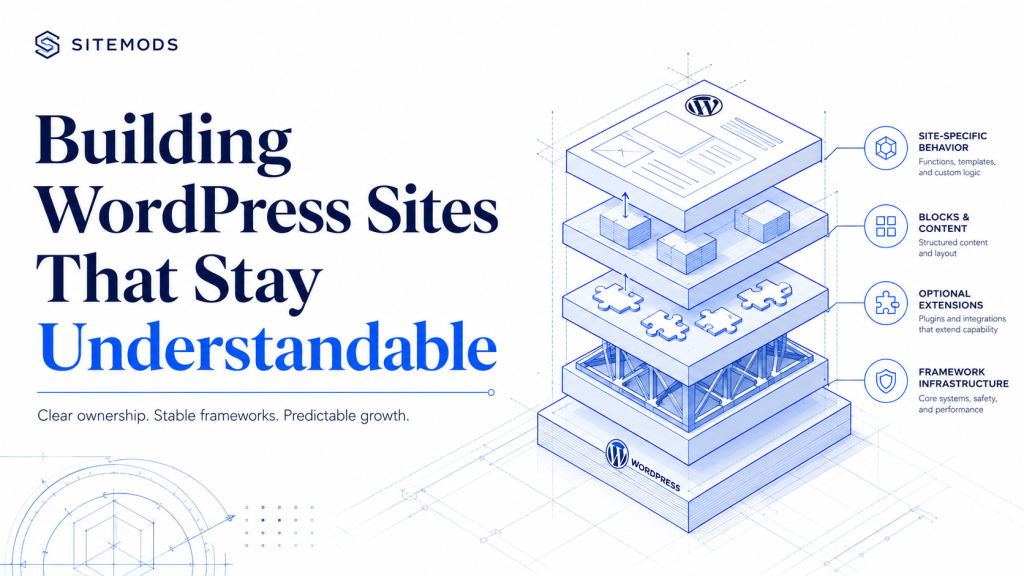
Structure Before Software
A maintainable website begins by separating shared infrastructure, optional capabilities, and project-specific behavior. That ownership model matters whether the work involves content, integrations, administration, presentation, or a feature that has not been imagined yet.
Good structure is not ceremony. It is how a future change becomes a focused decision instead of a reconstruction.
A WordPress Example
The blueprint above reflects the WordPress side of current SiteMods work. Native APIs, block metadata, theme configuration, registered assets, and standard settings flows provide the common language. Custom code still has an important role, but it should solve a real requirement instead of replacing behavior the platform already handles well.
- Load assets only in the context that needs them.
- Keep optional behavior inactive until it is selected.
- Preserve clear data ownership and predictable settings.
- Treat the editor and frontend as two views of the same content.
Use the Working Site as a Test
This SiteMods installation is both a public home for the development work and a practical implementation of it. Pages, posts, media, navigation, responsive layouts, framework updates, and optional integrations provide real conditions in which the underlying decisions can be reviewed.
The Development Journal records examples and implementation ideas as the system continues to evolve.
Leave a Reply
You must be Logged In to post a comment.